Mussolini's Greek Island by Sheila Lecoeur
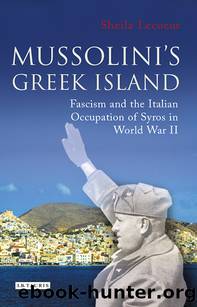
Author:Sheila Lecoeur [Lecoeur, Sheila]
Language: eng
Format: epub
Tags: Nonfiction, History, Italy, Social & Cultural Studies, Political Science
ISBN: 9780857738295
Publisher: Bloomsbury Publishing
Published: 2015-06-19T04:00:00+00:00
7: THE OCCUPIERS: SOLDIERSâ LIVES
Italyâs diminishing resources and failure to supply adequate military support increased the vulnerability of the outlying Aegean islands. In Syros, soldiersâ anxieties, which were generated by the lack of food, were compounded by the external events of the war and the decline in Axis supremacy. If fear alters the way people relate to each other and can reverse power relations, it may be possible to observe this process in the way soldiers behaved.1 In the build up to the Italian Armistice of 8 September 1943, the level of anxiety was constantly being raised. The circumstances of life in Syros imposed pressures on the occupiers, affecting their behaviour and experience of the occupation. This chapter will assess what it was like to live through this experience, how well soldiers were looked after by the army and how convincing they were as embodiments of Italian fascism. Also questions still remain unanswered about the dramatic events of the final stage of the Italian occupation and its sudden collapse.
Daily life
After the suffering and privations of the front, a small Greek island must have seemed to most soldiers to be a safer and more peaceful destination. But it was not long before emotions of âpainful homesicknessâ were recorded by those absent from home over long periods. In the Cyclades, most of the troops were not sent home on leave for extensive periods and in many cases not for the whole of the occupation â amounting to three years of active service.2 By 1942, even officersâ leave was cancelled as Allied attacks on the Aegean islands escalated.3
Soldiersâ sense of isolation was aggravated by a defective military postal system which left soldiers without contact with their families for long periods. Duca complained that letters sent by ship from Italy in September 1941, took three months and airmail took over a month. Even telegrams from Italy were held up at Bari from which they were sent by post to Rhodes and in a typical case â a postal order sending money home on the 6th August 1941, took seven weeks to arrive.4 Post was held up due to censorship in Rhodes or Samos, creating a heavy back-log â and soldiers were told to write shorter letters or to use official reply forms.5 Even the governor, Valeriani, had to survive for months without six suitcases of his personal luggage, which had been mislaid in transit. After a long and heated exchange of telegrams and letters, his bags were found in a warehouse in the port of Brindisi.6 Duca was concerned that restricted contact with their families had a considerable effect on his men, who blamed postal deficiencies on âlack of care from their superiorsâ.7 Soldiers were beginning to feel increasingly vulnerable because they suspected that their superiors could not really protect their interests.
Homesickness was compounded by physical isolation, driving some to disregard orders to keep their distance from the local population. In many places in Greece, Italian soldiers mingled with Greeks in public places. However,
Download
This site does not store any files on its server. We only index and link to content provided by other sites. Please contact the content providers to delete copyright contents if any and email us, we'll remove relevant links or contents immediately.
| Anthropology | Archaeology |
| Philosophy | Politics & Government |
| Social Sciences | Sociology |
| Women's Studies |
The Secret History by Donna Tartt(19088)
The Social Justice Warrior Handbook by Lisa De Pasquale(12190)
Thirteen Reasons Why by Jay Asher(8910)
This Is How You Lose Her by Junot Diaz(6887)
Weapons of Math Destruction by Cathy O'Neil(6280)
Zero to One by Peter Thiel(5802)
Beartown by Fredrik Backman(5754)
The Myth of the Strong Leader by Archie Brown(5507)
The Fire Next Time by James Baldwin(5446)
How Democracies Die by Steven Levitsky & Daniel Ziblatt(5219)
Promise Me, Dad by Joe Biden(5153)
Stone's Rules by Roger Stone(5088)
A Higher Loyalty: Truth, Lies, and Leadership by James Comey(4964)
100 Deadly Skills by Clint Emerson(4925)
Rise and Kill First by Ronen Bergman(4789)
Secrecy World by Jake Bernstein(4753)
The David Icke Guide to the Global Conspiracy (and how to end it) by David Icke(4720)
The Farm by Tom Rob Smith(4512)
The Doomsday Machine by Daniel Ellsberg(4490)
